What is sponge foam made of
Sponge is a kind of polyurethane foam which belongs to flexible polyurethane foam. Because of the porous honeycomb structure, it has the characteristics of excellent softness, elasticity, water absorption and water resistance, and is widely used in sofas, mattresses, clothing, flexible packaging and other industries.
1. Main raw materials
1.1 Polyether polyol
Sponges mostly use polyether propylene glycol and polyether glycerol, which have less functionality (2-3), low hydroxyl value and large molecular weight. The molecular formula is:
1.2 Organic isocyanates
The most commonly used is methylbenzene diisocyanate, referred to as TDI, there are two isomers, namely 2,4-TDI, 2,6-TDI. In the production of sponge 2,4-TDI accounts for 80%, 2,6-TDI 20%
1.3 Water
In the production of sponges, water is indispensable. Water reacts with TDI to release CO2 gas, which also plays a role in chain growth.
1.4 Catalyst
The catalysts that promote the reaction of polyether polyol with isocyanate to increase the chain are stannous octoate and dibutyltin. The catalysts that promote the cross-linking reaction and can promote the CO2 gas released from the reaction between isocyanate and water include triethanolamine, triethylenediamine, triethylamine, etc.
1.5 External foaming agent
Commonly used are low-boiling fluorocarbon compounds, such as monofluorotrichloromethane (F-11). Since it is not environmentally friendly, cyclopentane is generally used to replace F-11, or dichloromethane, and the effect is good. If it is not for the production of ultra-light density sponge, the proportion of main raw materials can also be adjusted appropriately, and external foaming agents are not used.
1.6 Foam stabilizer
(Foam stabilizer) Silicone foam stabilizer is commonly used. At present, silicon-carbon bond Si-C copolymer is mainly used, and the dosage is 0.5%-5%.
2. The synthesis principle of sponge
In the synthesis process of sponge, there are mainly chain growth reactions, foaming and cross-linking, etc. These reactions are related to the molecular structure, functionality, and molecular weight of raw materials.
2.1 Chain extension reaction
Isocyanate and difunctional polyether polyol chain extension reaction, because the excess isocyanate in the reaction is about 5%, so the final product of chain extension is isocyanate group, which is repeatedly promoted to make the chain grow rapidly.
2.2 The foaming reaction is accompanied by chain growth
In the process of producing the sponge, the foaming gas mainly comes from the reaction of TDI and water to generate a large amount of CO2 gas, and at the same time, the newly generated amine reacts with the isocyanate to generate a urea bond compound, which is repeated with chain growth.
2.3 Cross-linking reaction
The cross-linking reaction is very important for the preparation of sponge. If it occurs too early or too late, the quality of the sponge will decrease or even be scrapped.
2.3.1 Crosslinking of multifunctional compounds
The reaction between polyether polyol and isocyanate directly affects the density of the sponge. The molecular weight of the crosslinking point is 2000-20000. The smaller the molecular weight, the greater the crosslinking density, the higher the hardness of the foam, and the relative decrease in softness and elasticity.
2.3.2 Biuret Crosslinking
Water reacts with isocyanate to form a urea bond compound, which further reacts with isocyanate to form a tri-directional biuret cross-linking compound.
2.3.3 Allophanate Crosslinking
The hydrogen on the nitrogen atom in the urethane group reacts with the isocyanate to form an allophanate with a three-way cross-linked structure.
3. Sponge production technology and process
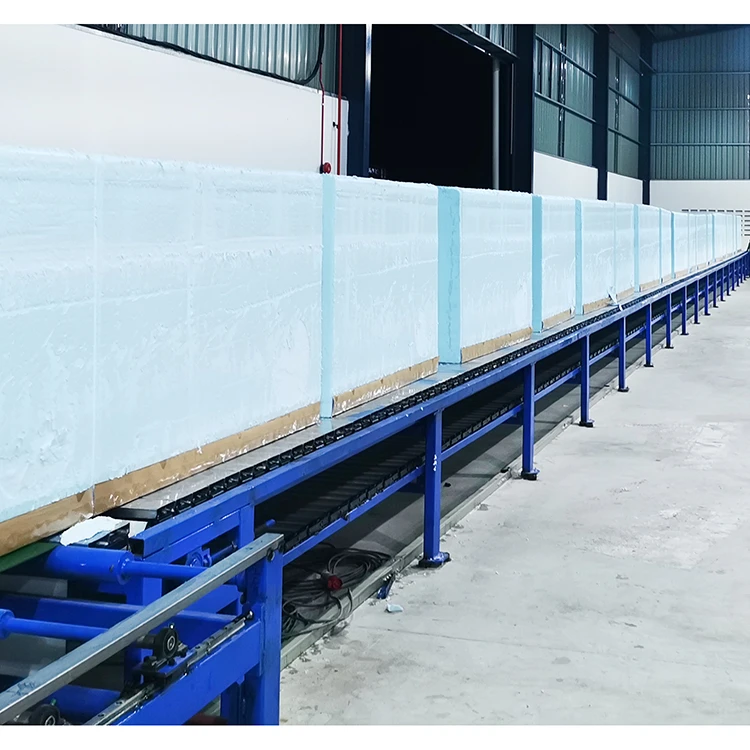
At present, most of the sponge production adopts the one-step box foaming method. Various raw materials are quickly added to the forming box under high-speed stirring, and the chain growth, foaming, cross-linking, curing and other reactions are completed in the forming box, so as to complete the sponge. Production. The advantages of this process are short process flow, low material viscosity, easy control, energy saving, small equipment investment, and wide range of applicable densities.